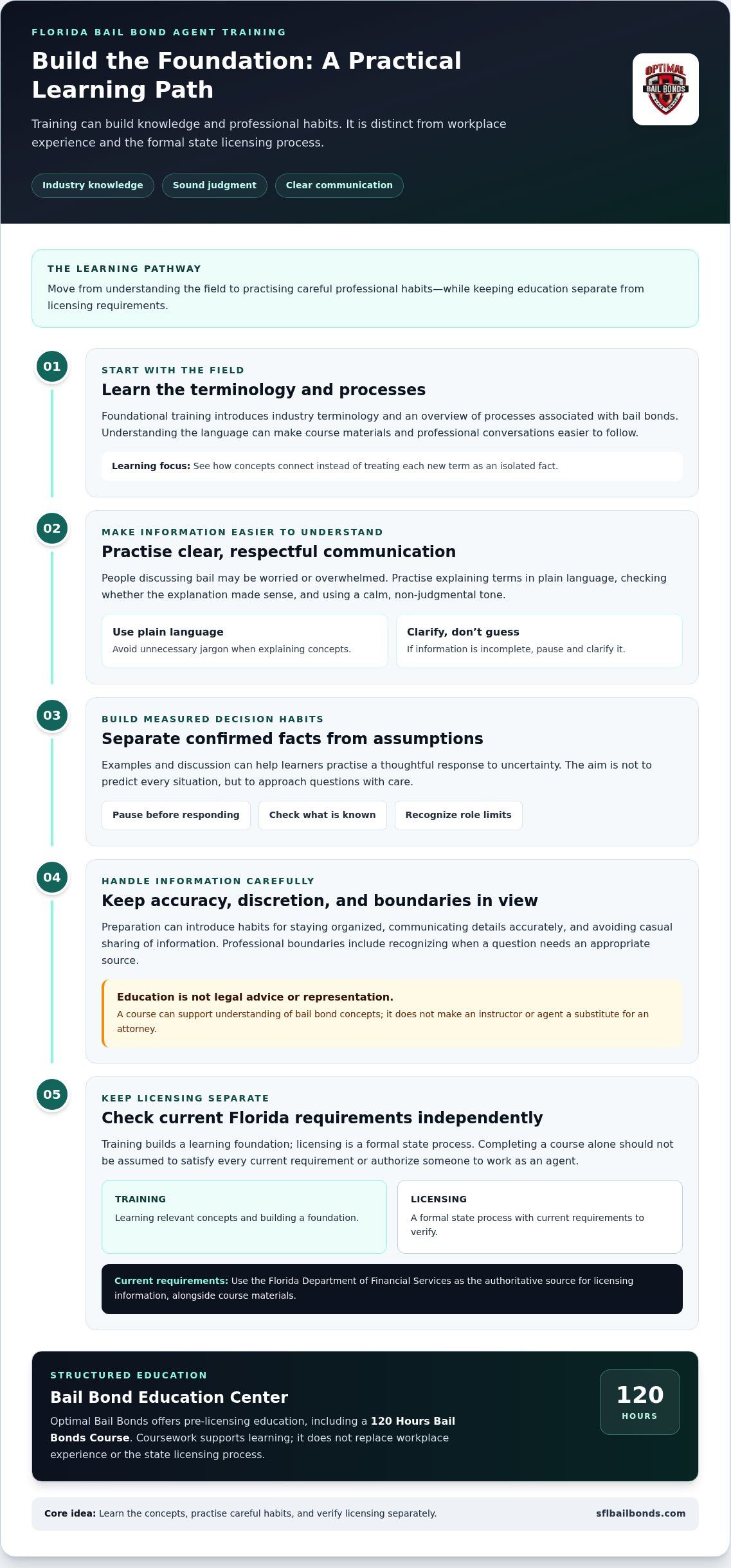
Training can help you connect industry concepts to practical questions, but coursework and workplace experience are not the same. A lesson may introduce terminology or explain how ideas relate. Applying that knowledge in a changing professional setting takes further learning and experience. A useful course can give you a foundation and a way to think through unfamiliar situations. It cannot promise mastery, employment, or a particular career outcome.
For Florida bail bond agent training, the value of applied learning depends in part on how instruction is structured. When a course includes scenarios, learners can practise interpreting information, identifying what they still need to clarify, and explaining a concept in plain language. Reflection can help, too. After considering an example, ask yourself what you understood, what remains uncertain, and where authoritative guidance may be needed.
What classroom learning can help you practise
Consider a hypothetical example in which someone uses an unfamiliar industry term. You might explain what it means in the context of the lesson, then notice whether the question also raises an issue that needs more information. This kind of exercise can build familiarity with concepts and encourage careful, measured communication. It illustrates how applied practice may work, rather than making a claim about a particular course’s contents.
When instruction includes examples or scenarios, focus on the reasoning process instead of guessing a single “right” response. Practise separating known details from assumptions, listing questions that need clarification, and identifying when to consult current official guidance. These habits make learning more active and reveal areas to review.
Practice has limits. Classroom exercises support understanding, but they do not replace workplace experience or formal state requirements. For current Florida licensing information, refer to the Florida Department of Financial Services.
What training cannot replace
A course should not be treated as a guarantee of career success or proof that every real-world situation will feel familiar. People and circumstances vary. Professional judgment develops over time, and a learner may need further guidance and experience to apply concepts confidently.
Training is also not the same as licensure or independent legal expertise. Keep those distinctions clear as you plan your next steps. Rules and professional contexts can change, so learning does not necessarily end when a course does. Revisiting current state information and continuing to strengthen your understanding can help you stay oriented as expectations evolve.
Approach education with realistic expectations: use it to build a foundation, practise thinking carefully, and identify what you still need to learn. That is meaningful preparation, even though it cannot replace the next stages of professional development.