florida-department-of-financial-services-bail-course-what-to-know-in-2026.jpg

Florida Department of Financial Services Bail Course: What to Know in 2026

Completing the required bail course is an important step, but education and receiving a license are not the same thing. The Florida Department of Financial Services bail course is part of a broader licensing process. Knowing what to review before enrolling can help you plan your next steps in Florida with confidence.

Florida’s current requirements include a state-approved 120-hour pre-licensing course and a separate state-approved correspondence course. Course completion alone does not grant a license, so review the latest DFS education, exam, application, and eligibility requirements for your situation. This guide explains how pre-licensing education fits into the process, what to compare before enrolling, and how to prepare for study.

Optimal Bail Bonds’ Bail Bond Education Center offers pre-licensing classes, including a 120 Hours Bail Bonds Course. If you are preparing to enter the field in Florida, use the course information to plan your learning and the current DFS guidance to understand the state’s licensing steps.

Key Takeaways

  • The Florida Department of Financial Services bail course is an education step, not a license. Understand how training fits into the wider licensing process.
  • Review current DFS terminology and requirements before enrolling, including the steps that apply to your situation.
  • Choose pre-licensing or continuing education based on your learner stage and current needs.
  • Keep official DFS guidance and course information together so you can refer to both as you prepare to study.
  • Optimal Bail Bonds offers pre-licensing education, including its 120 Hours Bail Bonds Course, for learners preparing to enter the field.

What Is the Florida Department of Financial Services Bail Course?

State licensing terms can be confusing when you are exploring bail-agent work for the first time. The Florida Department of Financial Services bail course refers to pre-licensing education within the state’s licensing pathway. Florida DFS oversees licensing for bail bond agents and agencies, while education providers deliver instruction. Completing a course is an education milestone, not a license or a guarantee that DFS will approve an application.

Current state guidance describes the required pre-licensing education as a DFS-approved 120-hour course, alongside a state-approved correspondence course. Review DFS guidance for the latest terminology and requirements that apply to your situation. A course provider supports your learning; DFS sets the applicable state requirements and makes licensing decisions.

For a high-level introduction to the profession, the Bail bondsman overview describes the role in a broader U.S. context. For Florida licensing requirements, use current state guidance.

What does the Florida Department of Financial Services do?

DFS oversees Florida’s bail-agent licensing process and sets the applicable licensing requirements. Education is one part of that process: a provider teaches the course, and DFS guidance explains which education and other steps applicants must complete. Keeping those roles clear helps prevent a common misunderstanding: enrolling in or completing a class does not authorize you to work as a licensed agent.

Who may be looking for a Florida bail course?

Prospective agents typically need pre-licensing information: which education applies, how it fits into the licensing path, and how to prepare for study. Existing agents have a different need: continuing education to support ongoing learning after licensure. Identify your stage before choosing a course so you focus on the right type of instruction. If you are still exploring the profession, read our Florida bail bondsman career guide for broader career context.

For structured pre-licensing instruction, Optimal Bail Bonds offers a 120 Hours Bail Bonds Course. Review the course information alongside current DFS guidance to understand how the course fits into your education plan. Course education can help you prepare, but licensing remains a separate state process.

How Bail-Course Education Fits Into Florida Agent Licensing

Bail-course education is one part of a larger licensing process, not a shortcut to a license. Start by identifying the license pathway you are considering. Then review current Florida Department of Financial Services (DFS) guidance and note the education that applies. Follow the relevant education, examination, application, and licensing steps in the order DFS currently specifies.

Use the state’s instructions as your reference when planning. Requirements and steps may depend on the pathway and current rules, so review DFS guidance before enrolling or submitting an application. This helps you distinguish a course description from the state’s licensing process.

Does completing a bail course automatically make you a licensed agent?

No. Completing a course does not automatically make you a licensed bail agent. Education providers deliver instruction; DFS handles licensing decisions under applicable state requirements. Course completion may be one part of the pathway, but prospective agents must also follow the current application and licensing requirements that apply to them.

Course completion documents education; only the state licensing process determines whether an applicant receives a license. Keep that distinction in mind as you evaluate a Florida Department of Financial Services bail course. A class can help you prepare for the educational portion of the process, but enrolling or completing the course does not guarantee approval.

Which requirements should prospective Florida agents verify?

Use current DFS guidance as your reference. Before choosing a course or moving to another licensing step, make a short checklist of the requirements relevant to your circumstances:

  • Eligibility: Confirm the current qualifications for the license pathway you are considering.
  • Education: Identify the required course type and whether additional education applies.
  • Examination: Check whether an exam applies and review the current instructions for completing it.
  • Application: Review the state’s application process and any required documentation.

Then compare your checklist with the course information. Optimal Bail Bonds offers a 120 Hours Bail Bonds Course for pre-licensing study. Use DFS guidance to map your education to the state’s licensing process, and keep the two separate: training provides instruction, while the state determines licensing.

How to Evaluate a Florida Bail Course Against Your Learning Needs

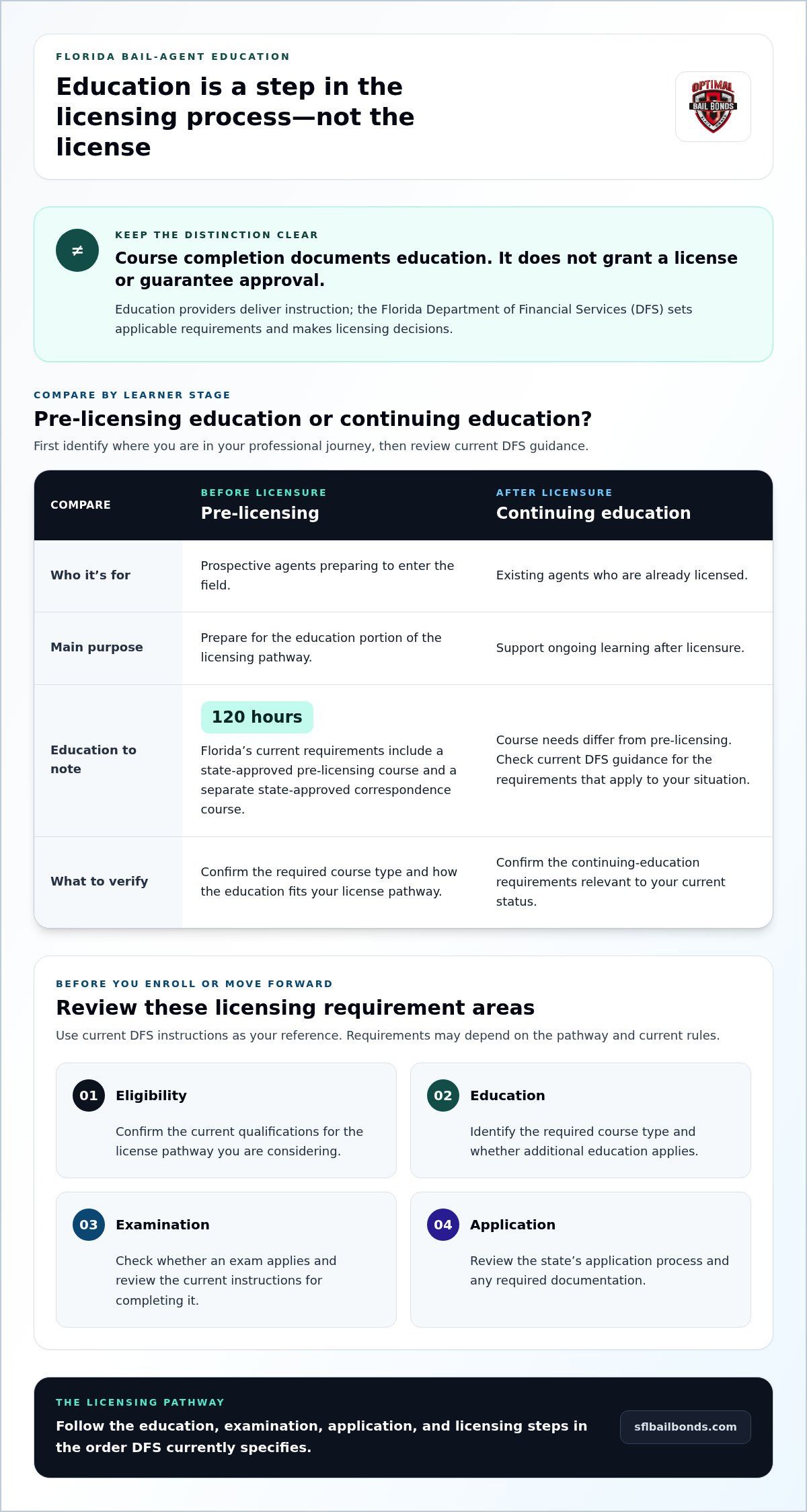
The right course depends on where you are in your professional journey. Someone preparing to enter the field needs pre-licensing education, while an already licensed agent may need continuing education. These courses serve different purposes. First identify your learner stage, then compare the course’s stated purpose with current Florida Department of Financial Services (DFS) guidance.

Consider a Florida Department of Financial Services bail course in the context of the requirements it is intended to support. Check DFS guidance for current requirements, then review the course purpose and completion expectations. This gives you two useful reference points: what the state requires and what the course covers.

Pre-licensing course or continuing education: which applies to you?

Pre-licensing education is for prospective agents preparing to enter the profession. Continuing education is for people who are already licensed and need ongoing learning. Your status and current state guidance determine which category applies and what requirements come with it. Check both before enrolling so you choose education for the right stage, rather than relying on a course label alone.

Education typeIntended learnerQuestions to verifyPre-licensingProspective agents exploring entry into the fieldDoes this course’s purpose align with current DFS education requirements for your pathway?Continuing educationAlready licensed industry professionalsDoes this course fit your current continuing-education needs and applicable state requirements?What course details should you understand before starting?

Clarify three points before you begin: the course’s purpose, how its content relates to current state requirements, and what completion involves. For example, distinguish instruction intended to support pre-licensing study from education designed for licensed agents. Then use DFS guidance to see how that category fits your circumstances. Keep course details and state information together, since each answers a different question.

Optimal Bail Bonds offers pre-licensing education, including a 120-hour bail bonds pre-licensing course. Review the course information alongside current DFS guidance to connect your learning goals with the state process. That is a practical starting point for planning your education, while keeping course completion distinct from a licensing decision.

infographic_1790998053_2WpPUrPt.jpg

How to Prepare for a Florida Bail Course: A Practical Sequence

How to Prepare for a Florida Bail Course: A Practical Sequence

Preparation can make course material easier to organize and review. Before you begin, create a simple reference system with current Florida Department of Financial Services (DFS) guidance, course information, study notes, and questions. Keeping these items together makes it easier to distinguish state requirements from lesson material as you study.

Before enrolling: confirm the current course pathway

Start with current state instructions, then identify which education category fits your stage. A prospective agent and an already licensed professional may have different education needs. Remember that course enrollment alone does not establish that you have met every state requirement.

  • 1. Review current DFS guidance. Note the education and licensing steps for your intended pathway. Check for updates instead of relying on old notes or saved information.
  • 2. Identify your learner stage. Decide whether you are preparing to enter the profession or seeking continuing education as a licensed professional.
  • 3. Compare the course purpose with your needs. Read the course information alongside DFS guidance. Use the state’s requirements to understand how education fits into the process.

While studying: build a steady preparation routine

Give the material a repeatable structure that works for you. Break lessons into manageable portions, revisit your notes, and keep a running list of questions. This creates a useful record of what you understand and what you want to review during instruction.

  • 4. Make a vocabulary list. Write unfamiliar regulatory or bail-bond terms in your own words. Add a question beside a term when you need clarification about how it relates to a course concept.
  • 5. Connect terms to concepts. Group related ideas and note how they fit together in the material. This turns specialized language into information you can review with purpose.
  • 6. Track what remains unclear. Separate questions about course content from questions about state requirements. Use instruction to work through course topics and current DFS guidance for licensing information.

For a Florida Department of Financial Services bail course, this routine keeps your learning organized and helps distinguish lesson material from state instructions. Adjust your study sessions to your needs, and use your notes to guide review. A study routine is a preparation tool, not a guarantee of exam or licensing results.

bail bond education resources

Start Your Florida Bail-Bond Education With Optimal Bail Bonds

Once you know which type of education fits your stage, structured instruction can give you a clear place to begin. Optimal Bail Bonds’ Bail Bond Education Center offers pre-licensing classes for prospective agents and continuing-education classes for licensed industry professionals. Match the course purpose to your goals, then use current Florida Department of Financial Services (DFS) guidance to understand the requirements for your pathway.

What Optimal Bail Bonds’ education center offers

For prospective learners, the center offers the 120 Hours Bail Bonds Course. The center also offers continuing-education classes for licensed industry professionals. These options serve different learner stages. Instruction can help you approach bail-bond concepts in a structured way, while the state sets its licensing requirements and makes licensing decisions.

If you are still considering the profession, learn more about how to become a bail bondsman in Florida as you clarify your goals. Then review the course information alongside the DFS requirements relevant to your situation. This connects your training plans with the wider licensing pathway.

Choose a clear next step toward bail-agent training

You can take an educational next step while continuing to organize your licensing questions. Begin with the course details, note its purpose and completion expectations, and compare them with current state guidance. Keep the distinction clear: taking a course supports learning, but enrollment or completion does not issue a license or guarantee approval.

If you are preparing to enter the field, a pre-licensing class can provide organized instruction as you build familiarity with industry concepts. Use your questions and study notes to guide your learning, and refer to DFS information for official requirements.

Explore the 120 Hours Bail Bonds Course

Before acting on your education plan, review current licensing rules and requirements directly with the Florida Department of Financial Services.

Take Your Next Step With a Clear Education Plan

Choosing a Florida Department of Financial Services bail course starts with knowing where education fits in the licensing pathway. Pre-licensing instruction is for prospective agents, while continuing education serves licensed professionals. In either case, course completion is an education step, not a license or a guarantee of approval.

Before enrolling, match the course purpose to your learning stage and compare its information with current DFS guidance. Keep state requirements and course materials together, and use your notes to track questions as you study. This simple organization can make an unfamiliar process easier to approach.

Optimal Bail Bonds offers pre-licensing and continuing-education classes, including the 120 Hours Bail Bonds Course. Explore the education options as your next step, and review current licensing requirements directly with the DFS.

Explore bail-bond education at Optimal Bail Bonds

Move forward one informed step at a time: build your understanding through structured learning, keep official guidance close, and stay focused as you explore the profession.

Frequently Asked Questions

Is a Florida Department of Financial Services bail course required to become a bail agent?

Florida’s bail-agent licensing pathway includes pre-licensing education. Review current Florida Department of Financial Services (DFS) guidance for the course terminology and requirements that apply to you. Education is one step in the pathway, not a license. Before enrolling, check the applicable education and other licensing steps for your circumstances.

What does a Florida bail bond pre-licensing course teach?

A pre-licensing course provides education for people preparing to enter the bail-bond profession. Subjects and course structure depend on the course, so review its information and compare it with current Florida guidance. Education can help you prepare, but it does not replace any separate application, examination, or licensing steps required under current DFS rules.

How many hours is the Florida bail bonds course?

Florida’s current state guidance describes a 120-hour pre-licensing course, alongside a separate state-approved correspondence course. Optimal Bail Bonds offers a 120 Hours Bail Bonds Course. Review the latest DFS instructions and the course information as you plan your education.

Does completing a bail course guarantee a Florida bail agent license?

No. Completing a course does not guarantee that you will receive a Florida bail agent license. A course supports education and preparation, while the state’s licensing process determines whether an applicant meets current requirements. Check the relevant DFS guidance to identify the other steps that apply to your situation.

Can I take a Florida bail course before applying for a license?

Pre-licensing education is intended for people preparing to enter the bail-bond profession. Review current Florida guidance for the timing and any eligibility rules that apply. Start by identifying the education for your learner stage and noting questions before enrolling. Taking a course is an education step, not proof that you have completed every requirement or received a license.

What is the difference between pre-licensing and continuing education for bail agents?

Pre-licensing education is for prospective agents preparing to enter the field, while continuing education serves people who are already licensed. The courses have different purposes and are not interchangeable simply because both relate to bail bonds. Check current DFS guidance to identify the education relevant to your status and circumstances.

Where can I find a Florida bail bonds pre-licensing course?

Optimal Bail Bonds offers pre-licensing bail-bond classes through its education center, including the 120 Hours Bail Bonds Course. Review the course information to understand its purpose, then compare it with current Florida Department of Financial Services requirements. Education supports preparation, while the state handles licensing decisions.