Florida DFS and Bail Bonds: What Every Future Bail Bond Agent Needs to Know

If you are planning to become a bail bondsman in Florida, you will quickly become familiar with three letters: DFS. In the bail bond industry, DFS refers to the Florida Department of Financial Services, the state agency that plays a central role in licensing, regulating, monitoring, and investigating bail bond agents and bail bond agencies.

For students entering the profession, understanding DFS is just as important as learning how to write a bond. The Department is involved from the time you begin the licensing process through the years you remain active as a bail bond agent. DFS oversees qualifications, applications, fingerprints, examinations, appointments, continuing education, compliance, and investigations involving Florida bail bond professionals. Its Division of Insurance Agent and Agency Services specifically provides licensing, education, compliance, and industry information for limited surety bail bond agents and related licensees.

For anyone beginning this career, the foundation starts with approved pre-licensing education. Our Florida 120-Hour Bail Bond Pre-Licensing Course is designed to help aspiring agents understand not only the bail process, but also the regulatory responsibilities they will encounter throughout their careers.

Blitz Image Placeholder.jpg

What Is the Florida Department of Financial Services?

  • he Florida Department of Financial Services is a large state agency with responsibilities extending far beyond bail bonds. Within DFS, however, the Division of Insurance Agent and Agency Services handles many matters affecting insurance professionals, including limited surety bail bond agents.

    The Division provides information covering licensing qualifications, applications, education, state examinations, appointments, compliance requirements, and investigations. It also operates services such as MyProfile, licensee searches, and appointment systems used by Florida insurance professionals.

    For a new bail bond agent, DFS can be thought of as the regulatory center of the licensing process. You may take your education through an approved provider and ultimately work for a private bail bond agency or surety company, but DFS determines whether you have met the state's licensing requirements.

    That makes understanding DFS essential for anyone considering a career in Florida bail bonds.

  • Blitz Image Placeholder.jpg

    Why DFS Matters to Future Bail Bond Agents

    A bail bond agent assumes significant financial and legal responsibilities. Agents handle premiums, collateral, contracts, court obligations, powers of attorney, records, forfeitures, and information concerning defendants and indemnitors. Florida therefore requires people entering this profession to satisfy specific qualifications before they can lawfully conduct bail bond business.

    DFS is responsible for administering many of these requirements.

    Florida's licensing information currently identifies the 2-34 Limited Surety Bail Bond Agent license as the resident license used by an individual appointed by an insurer to execute or countersign bail bonds. DFS also lists the 2-37 Professional Bail Bond Agent license.

    This is why students should begin learning how DFS operates while they are completing their training. Licensing is not simply a matter of finishing school and receiving a certificate. It is a regulated process involving education, application review, background screening, examination, and ultimately the authority necessary to conduct bail bond business.

    Our article Florida's 120-Hour Pre-Licensing Bail Bond Course: Your First Big Step explains why education should be viewed as the beginning of a professional licensing process rather than simply another class.

    Blitz Image Placeholder.jpg

    DFS and the Florida 120-Hour Pre-Licensing Course

  • One of the most important requirements prospective bail bond agents encounter is Florida's 120-hour approved basic certification course.

    DFS's current licensing guidance for the resident 2-34 Limited Surety Bail Bond Agent states that an applicant must successfully complete 120 hours of an approved basic certification course in the criminal justice system with a grade of at least 80 percent, and that the course must have been completed within the preceding two years.

    The course is important because a bail bond agent must understand much more than simply how to collect a premium or post a bond.

    Students need exposure to subjects such as Florida Statutes Chapter 648, Chapter 903, licensing requirements, contracts, surety relationships, collateral, forfeitures, judgments, surrender procedures, recordkeeping, prohibited practices, and the responsibilities imposed on licensed agents.

    Our 120-Hour Bail Bond Pre-Licensing Course provides live online instruction through Zoom with different scheduling options designed for students who may be balancing work and family responsibilities.

    Students can choose from weekend classes, part-time evening classes conducted Monday through Thursday, or full-time classes. The goal is the same regardless of the schedule: complete the required education while developing the knowledge necessary for the licensing examination and the responsibilities that come afterward.

    If you are researching how to enter the profession, also read Become a Bail Bondsman: Start With the 120-Hour Course.

  • Blitz Image Placeholder.jpg

    Applying for a Florida Bail Bond License

    Completing the education requirement does not automatically create a bail bond license.

    A prospective agent must apply through the licensing process administered by DFS. The Department's current guidance explains that applicants must complete the online application, answer the required questions, and pay applicable licensing fees. Fingerprinting costs are separate and are generally paid directly to the fingerprint vendor.

    The qualifications are substantial

    According to DFS's current resident limited surety licensing guidance, an applicant must be a natural person who is at least 18 years old, possess a high school diploma or equivalent, be a Florida resident, and satisfy citizenship or lawful work-authorization requirements. Applicants must also meet statutory character and business-location qualifications.

    Florida Statute 648.34 also requires sworn recommendations from at least three reputable citizens residing in the counties where the applicant proposes to engage in the bail bond business. DFS maintains a specific Limited Surety Agent and Professional Bail Bond Agent Sworn Statement form for this purpose.

    For prospective students, this is an important distinction: education prepares you to qualify, but DFS controls the licensing process.

    Fingerprints and Background Investigations

    Florida bail bond applicants are subject to background screening.

    The Department does not simply rely on information written on an application. Fingerprints and criminal-history information are part of the qualification process because bail bond agents occupy a position involving money, property, defendants, court obligations, and public trust.

    DFS's licensing materials direct applicants to complete fingerprinting as part of the licensing process.

    Florida statutes also authorize comprehensive investigations into an applicant's qualifications, character, experience, background, and fitness.

    Students sometimes focus almost entirely on passing the examination, but background requirements deserve equal attention. Applicants should answer licensing questions accurately and completely. Attempting to conceal disqualifying or reportable information can create problems beyond the underlying incident itself.

    DFS ultimately evaluates whether the applicant satisfies Florida's licensing standards.

    The Florida Bail Bond State Examination

    Once an applicant satisfies the necessary prerequisites and receives authorization, the next major step is the Florida bail bond licensure examination.

    Florida Statute 648.38 provides that an approved applicant must personally take the written examination prepared by DFS or its designated testing provider. The examination is intended to determine whether the applicant has an adequate level of knowledge and competence to perform the duties and responsibilities of a bail bond agent.

    The statute also states that the examination's scope is as broad as the bail bond business.

    That language matters.

    Students should not prepare by memorizing only a few definitions. The examination can require an understanding of how different rules interact in practical situations. A question might involve licensing, premiums, collateral, forfeiture deadlines, appointments, surrender, recordkeeping, or several concepts at once.

    A strong study strategy should therefore combine statute review with scenario-based practice.

    For example, our Florida bail bond scenario study materials contain more than 100 application-style questions covering subjects such as licensing and appointments, contracts, operating a bail bond business, arrest and release, underwriting, courts and jurisdiction, forfeitures and judgments, collateral, indemnity, and regulatory responsibilities.

    Learning definitions is equally important. Terms such as appointment, bail bond agent, collateral, forfeiture, indemnitor, limited surety agent, power of attorney, premium, remission, surety, surrender, and judgment form the vocabulary of the profession.

    The Difference Between a License and an Appointment

    One of the most important concepts for new bail bond agents is the difference between being licensed and being appointed.

    A license establishes that the individual has satisfied the state's qualifications to hold that type of license.

    An appointment gives the licensee authority to act for an appointing entity.

    For a limited surety agent, the appointment is particularly important because the agent generally acts through an insurer's authority and power of attorney.

    DFS's licensing pages emphasize the importance of appointments in insurance licensing, while its bail bond compliance materials explain that a limited surety agent is an individual appointed by an insurer to execute bail bonds in connection with court proceedings.

    The distinction frequently appears in examination questions because it is fundamental to understanding lawful bail bond operations.

    A newly licensed agent should never assume that receiving the license alone authorizes the writing of bonds for any insurer.

    DFS and Bail Bond Agent and Agency Appointments

    DFS also plays a central role in appointment administration.

    According to the Department's current bail bond licensing FAQ, bail bond agents and bail bond agencies are appointed electronically through eAppoint, and the surety company submits the appointment. Before an appointment is made, the appointing surety company must obtain the required sworn statement from the proposed appointee.

    This connects directly with Florida Statute 648.382, which governs appointments of bail bond agents and bail bond agencies.

    The appointment process helps establish who has legal authority to represent an insurer in Florida's bail bond market. It also creates a formal regulatory record linking the licensed agent or agency with the appointing company.

    DFS maintains appointment forms, termination forms, sworn statements, and other bail bond-specific documents for these purposes.

    For students, this reinforces an important career lesson: passing the course and examination gets you closer to practicing, but professional relationships with properly authorized agencies and sureties are also essential.

    DFS Compliance After You Become Licensed

    DFS does not disappear after the license is issued.

    A bail bond agent remains subject to regulatory requirements throughout the period of licensure.

    Florida's bail bond laws regulate areas including advertising, premiums, solicitation, records, collateral, appointments, agency operations, fiduciary responsibilities, reporting, and prohibited conduct.

    DFS's Bail Bonds Overview provides guidance on several operating requirements and explains that Florida law requires a person performing bail bond functions to be properly qualified, licensed, and appointed.

    The Department's compliance pages also provide information for active agents and agencies, including guidance on agency operations and categories of people who may be prohibited from ownership or employment in certain bail bond agency roles.

    Students should therefore think beyond the state exam. The purpose of pre-licensing education is not merely to pass a test. It should create the knowledge base necessary to remain compliant after receiving the license.

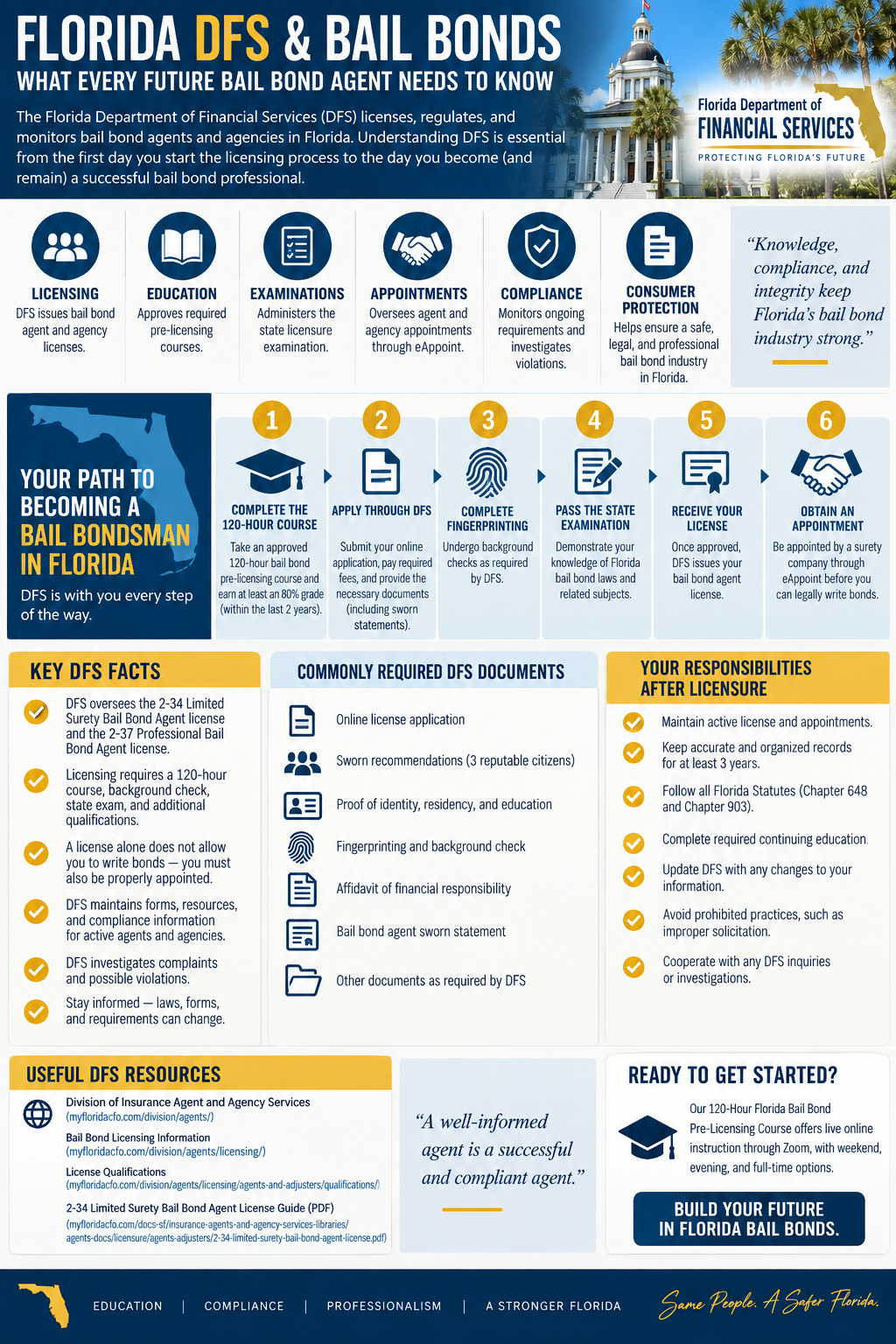
    infographic.png

    Records, Forms, and Reporting Requirements

    Good recordkeeping is one of the most important habits a new bail bond agent can develop.

    Florida Statute 648.36 requires bail bond agents to maintain records concerning bonds they execute or countersign for at least three years after the surety's liability has terminated. Those records must be available for examination and inspection.

    DFS provides numerous official forms specifically related to bail bond activities, including appointment forms, appointment termination forms, bail bond agent address-change forms, sworn statements, financial statements for professional bail bond agents, and other regulatory documents.

    An organized agent should be able to document what happened on a bond from beginning to end.

    That includes the bond itself, power of attorney information, premium documentation, collateral documentation when applicable, indemnity agreements, court notices, forfeiture records, surrender documents, cancellation information, and other records required by law or company procedures.

    Recordkeeping is not just paperwork. It is part of regulatory compliance and professional risk management.

    DFS Investigations and Enforcement

    DFS also investigates possible violations of Florida's insurance and bail bond laws.

    The Division of Insurance Agent and Agency Services describes its compliance section as providing licensees and consumers with information about the investigative process conducted by the Bureau of Investigation.

    Investigations may arise from complaints, regulatory reviews, record issues, licensing concerns, prohibited activity, financial irregularities, advertising practices, or other circumstances falling under the Department's authority.

    For a licensed agent, cooperation and accurate records can be extremely important.

    Florida's bail bond statutes contain numerous provisions where intentional or prohibited conduct may carry administrative or criminal consequences. A professional agent should therefore treat compliance as part of daily business operations rather than something considered only when an investigator contacts the agency.

    Frequently Asked Questions About DFS and Florida Bail Bonds

    What does DFS stand for in Florida bail bonds?

    DFS stands for the Florida Department of Financial Services. Its Division of Insurance Agent and Agency Services handles many licensing, education, appointment, and compliance matters involving Florida bail bond agents.

    Does DFS issue bail bond licenses?

    Yes. DFS administers Florida's bail bond agent licensing process. The Department currently identifies the resident 2-34 Limited Surety Bail Bond Agent and 2-37 Professional Bail Bond Agent license classifications.

    Do I need the 120-hour course before becoming a Florida bail bond agent?

    Applicants for the 2-34 Limited Surety Bail Bond Agent license must complete an approved 120-hour basic certification course and earn at least an 80 percent grade as part of the licensing requirements. DFS's current guidance states that this education must have been completed within the preceding two years.

    You can learn about available schedules through our 120-Hour Florida Bail Bond Pre-Licensing Course.

    Is the 120-hour class the same as the state exam?

    No. The pre-licensing course provides required education. The state licensure examination is a separate step used to test whether an applicant possesses sufficient knowledge and competence.

    Does DFS perform a background check?

    Applicants are subject to fingerprinting and background-review requirements as part of the licensing process.

    Is receiving a Florida bail bond license enough to immediately start writing bonds?

    Not necessarily. For limited surety agents, the appropriate appointment is also required before conducting business for an insurer. DFS maintains the eAppoint system used for appointment processing.

    Who appoints a Florida limited surety bail bond agent?

    The appointing surety company or managing general agent handles the appointment process as provided by Florida law. DFS's current guidance states that bail bond appointments are submitted through eAppoint.

    Can DFS investigate a licensed bail bond agent?

    Yes. DFS's Division of Insurance Agent and Agency Services includes a Bureau of Investigation responsible for investigating matters within its regulatory authority.

    Where should a new bail bond student begin?

    A strong starting point is understanding the education and licensing process before submitting an application. Read Florida's 120-Hour Pre-Licensing Bail Bond Course: Your First Big Step and Become a Bail Bondsman: Start With the 120-Hour Course for additional guidance.

    How Bail Bond Agents Can Stay Compliant With DFS

    The best way to remain in good standing is to build compliance into everyday operations.

    Agents should regularly verify that their license and appointments remain active, keep their contact and agency information current, maintain organized records, handle premiums and collateral according to applicable law, complete continuing education requirements, avoid prohibited solicitation, and stay current on changes to Chapter 648, Chapter 903, and applicable administrative rules.

    DFS itself maintains industry alerts, licensing pages, education resources, compliance information, and official forms. Checking those resources regularly is a good habit because laws, forms, administrative procedures, and licensing requirements can change.

    That is also why education should not stop when the 120-hour course ends.

    A successful bail bond agent must continue learning throughout his or her career.