How to Become a Bail Bondsman in Florida: The 2026 Career Guide

What if your next career move allowed you to stand as a pillar of support for families in crisis while building a stable, professional future? You likely already know that the path to this career is demanding, filled with strict Florida Department of Financial Services regulations and high educational hurdles. It's natural to feel overwhelmed by the 120-hour course requirements or the pressure of the state exam. This guide simplifies exactly how to become a bail bondsman in Florida, providing a clear roadmap through the legal maze so you can focus on your professional growth.

Mastering these steps requires more than just memorizing statutes; it demands a mentor who understands the weight of the industry. We'll walk through the mandatory 120-hour pre-licensing education, the necessary correspondence courses, and the updated licensing rules that replaced the old temporary license system. You'll gain the clarity needed to navigate the $50,000 surety bond requirement and the background check process. By the end of this guide, you'll have a complete checklist to transition from a motivated student to a licensed professional agent ready to serve the South Florida community with integrity and confidence.

Blitz Image Placeholder.jpg

Florida Bail Bond Licensing Prerequisites

  • The path to a new career starts with a clear understanding of the rules. The Florida Department of Financial Services (DFS) oversees the industry with a watchful eye, acting as both a regulator and a gatekeeper. They ensure every Bail bondsman operating in the state meets rigorous ethical and professional standards. Learning how to become a bail bondsman in Florida begins with these foundational requirements, which are designed to protect the public and the integrity of the legal system.

    Age and Residency Requirements

    You must be at least 18 years old to begin this journey. Florida law requires all applicants to be United States citizens or legal aliens with valid work authorization. Residency is also a non-negotiable factor. To qualify for licensure, you must be a bona fide resident of Florida. This ensures you're accessible to the local courts and the clients you serve. Certain professions are barred from holding a license to avoid conflicts of interest. If you currently serve as a law enforcement officer, jailer, attorney, or court employee, you'll need to transition out of those roles before applying.

    Educational Foundations

    Academic requirements start with a high school diploma or its equivalent, such as a GED. This foundation is necessary because the role involves complex legal documentation and a deep understanding of Florida statutes. You'll eventually need to complete specialized training where an 80% passing grade is the standard for success. Without this baseline education, the advanced pre-licensing coursework would be nearly impossible to master. It’s the first step in building the professional literacy required for the job.

    The Background Check and Moral Turpitude

    Florida takes the "good moral character" requirement seriously. The DFS uses a Livescan fingerprinting process to conduct a thorough criminal history check. This isn't just a formality. Certain offenses, particularly those involving "moral turpitude" or felonies, can permanently disqualify you from licensure. Moral turpitude refers to acts that are inherently base or vile, which contradict the high ethical standards of the bail industry.

    Honesty is your best strategy. Disclosing past mistakes is always better than having the DFS discover them during the audit. If you've faced legal challenges in the past, it's wise to consult with a mentor to see if those specific issues are disqualifiers. The state looks for reliability and integrity. They want to know that when a family is in distress, they're working with someone they can trust. This vetting process is rigorous, but it's what makes a Florida bail bond license a mark of true professional dedication.

  • Blitz Image Placeholder.jpg

    Step 1: Complete Your Pre-Licensing Education

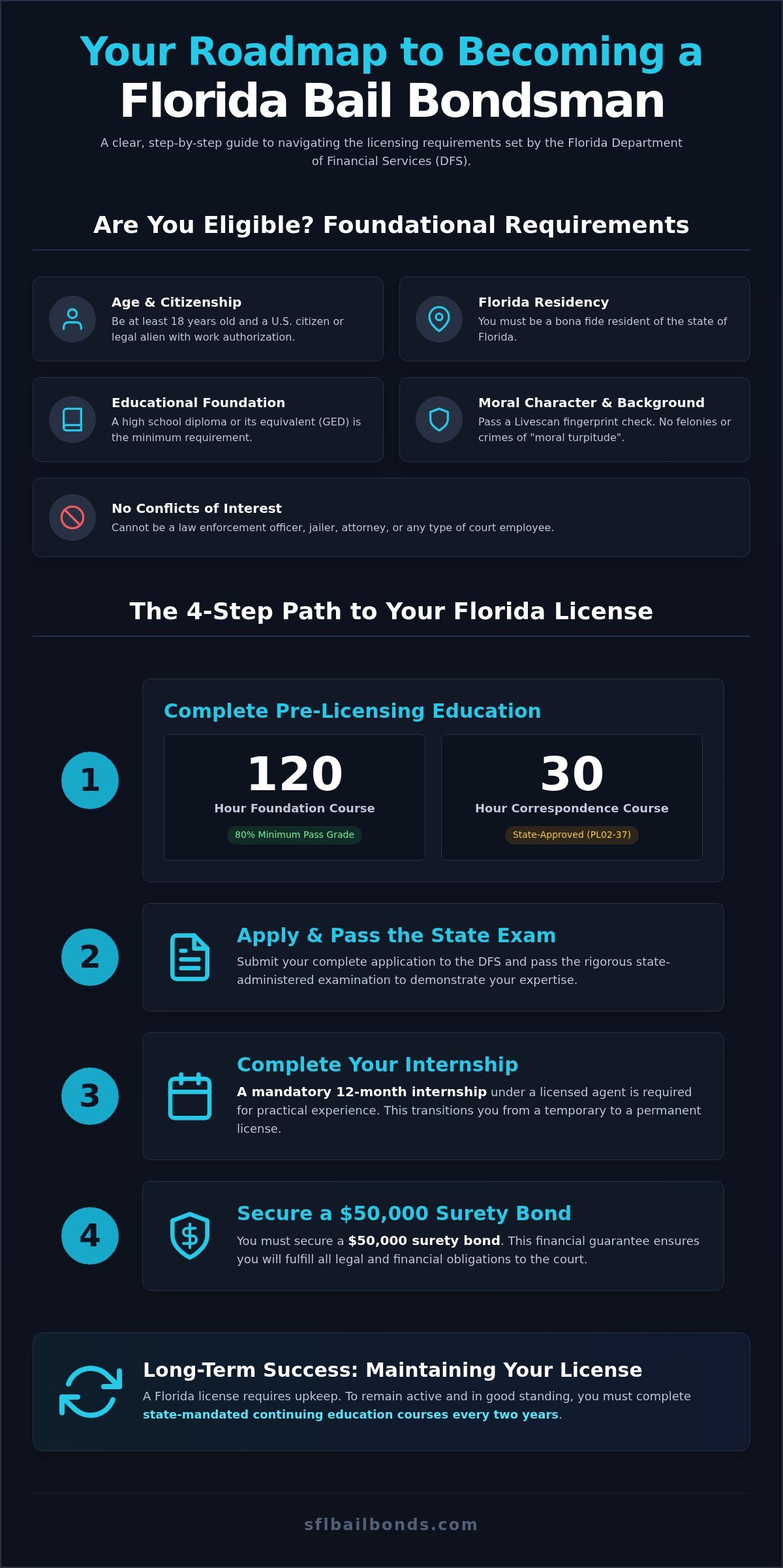
    Education is the bedrock of your future career. It transforms you from an interested applicant into a knowledgeable professional capable of navigating the high-stakes world of the Florida legal system. To understand how to become a bail bondsman in Florida, you must first commit to a rigorous academic path defined by the Florida Statutes for bail bond agents. This isn't just about checking boxes; it's about gaining the specialized knowledge required to protect both your clients and your license.

    The 120-Hour Foundation Course

    The 120-hour basic certification course serves as your primary introduction to the industry. This comprehensive program dives deep into the mechanics of the criminal justice system, covering everything from contract law to the specific procedures of arrest and release. You'll study the ethical boundaries of the profession and the legal frameworks that govern surety bonds. Because the state demands excellence, you must achieve a minimum 80% passing grade on the course exams to receive your certificate of completion. Many students find that choosing a format that fits their life, whether through interactive webinars or traditional classroom settings, is key to mastering this volume of information. It’s a challenging hurdle, but it's designed to ensure you're fully prepared for the realities of the field.

    The 30-Hour Correspondence Requirement

    In addition to the foundational 120-hour course, Florida requires a state-approved correspondence course for bail bond agents. This 30-hour supplemental training, often referred to as the PL02-37 requirement, builds upon your initial studies by focusing on the practical application of Florida’s insurance and bail laws. You have a two-year window from the time you complete your education to apply for your license, so managing your timeline is critical. This secondary course reinforces your understanding of the regulatory nuances you'll face daily. Like the primary course, this supplemental training also requires an 80% passing grade to qualify. Completing both requirements demonstrates your diligence and professional dedication to the Department of Financial Services.

    Choosing the right partner for this journey makes all the difference. At Optimal Bail Bonds, we function as a state-approved Bail Bond Education Center, offering the mentorship and expertise you need to thrive. If you're ready to take the first step, consider enrolling in our Pre-Licensing Bail Bonds Class to begin your professional transformation.

    Blitz Image Placeholder.jpg

    Step 2: The DFS Application and State Exam

  • Once you've secured your educational certificates, you're ready to step into the formal licensing phase. This transition from student to candidate is where your preparation meets the state's rigorous standards. Understanding how to become a bail bondsman in Florida requires a methodical approach to the Department of Financial Services (DFS) application process. This isn't just about paperwork; it's the moment you prove your professional readiness to the regulators who oversee the industry.

    Filing Your Formal Application

    The MyProfile portal is the primary gateway for all Florida insurance and bail bond licensing. You'll need to create an account and meticulously upload your documentation. Accuracy here is vital because errors can lead to frustrating delays in your career timeline. Ensure you have your high school diploma, the 120-hour course certificate, and your 30-hour correspondence certificate ready for digital submission. You'll also encounter several non-refundable costs during this stage. The state requires a $55 application fee and a $48.55 fingerprinting fee, plus local taxes, to initiate your background review. Tracking your status through the portal allows you to respond quickly if the DFS requests additional information or clarification regarding your history.

    Mastering the Florida Bail Bond Exam

    Passing the state exam is the final academic hurdle before you can begin your practical training. The test is comprehensive, focusing heavily on Florida Statutes Chapters 648 and 903. You'll face questions on the legalities of bail contracts, the ethical obligations of an agent, and the specific procedures for bond forfeitures. Scheduling your exam through the state's testing provider costs $44 per attempt. While the pressure of a high-stakes exam can be intimidating, remember that your pre-licensing education has already laid the groundwork for your success.

    Effective study strategies involve more than just rote memorization. You should focus on the "why" behind the laws to ensure you can apply them in real-world scenarios. If you don't pass on your first try, don't lose heart. You can retake the exam, though each attempt requires a new fee and a scheduled appointment. Use any unsuccessful attempts as a diagnostic tool to identify which legal areas need more of your attention. Once you see that "Pass" notification, you've cleared the most significant regulatory barrier to your new career, moving you one step closer to your 12-month internship.

  • infographic (5).jpg

    Step 3: The 12-Month Internship Phase

    Passing the state exam is a massive achievement. It marks the moment you transition from a student of the law to a practitioner in training. However, the classroom cannot fully prepare you for the adrenaline and responsibility of a midnight jail release. This is where the 12-month internship phase becomes your most valuable asset. Learning how to become a bail bondsman in Florida requires this hands-on immersion to ensure you can handle the complexities of the legal system with both speed and empathy. It’s a period of growth that turns academic theory into professional expertise.

    Securing Your Temporary License

    Once you've cleared the state exam, you'll apply for your temporary status, historically known as the Type 2-34 license. This designation allows you to work under the direct supervision of a veteran agent. You must complete 12 months of full-time employment, which the state defines as a minimum of 30 hours per week. During this year, you're an apprentice. You can't execute bonds or sign powers of attorney independently. Instead, you'll work side-by-side with your supervisor to learn the nuances of risk assessment and the ethical boundaries of the trade. This period is a 12-month evaluation of your character and diligence.

    The Internship Experience in South Florida

    Finding a supervising agent in a competitive market like Miami or Ft. Lauderdale requires a proactive approach. You're looking for more than just a job; you're seeking a mentor who understands the high-stakes South Florida legal environment. Your daily responsibilities will be diverse and demanding. You'll assist with underwriting new bonds, managing collateral, and coordinating with court officials. You'll also learn the logistical side of the business, such as how to navigate various county jails and build relationships with law enforcement personnel. This is your time to build a professional network that will support your career for decades to face.

    The transition from a trainee to a trusted professional happens one bond at a time. It’s about showing up when the phone rings and providing a calming presence for families in distress. If you're ready to start this journey with a team that values integrity and professional development, reach out to our Florida Bail Bonds agency to learn about our community-focused approach to the industry. We believe that the best agents are those who view their work as a vital service to the justice system and the people within it.

    Blitz Image Placeholder.jpg

    Building Your Career with Optimal Bail Bonds

    Completing your 12-month internship is the final bridge between training and full professional autonomy. Once you submit your certificate of completion to the state, you finally transition to a Limited Surety Agent (Type 2-35) license. This is the goal you've worked toward since first researching how to become a bail bondsman in Florida. It grants you the power to execute bonds independently and build your own reputation within the South Florida legal community. This permanent license is the foundation of a stable and rewarding career.

    Post-Licensing and Continuing Education

    Licensure is a commitment to lifelong learning. Florida law requires all active agents to complete 14 hours of continuing education every 24 months. These credits ensure you remain compliant with the latest changes to Chapters 648 and 903 of the Florida Statutes. Our state-approved Education Center provides these essential courses, maintaining the same high standards as our pre-licensing classes. Remember that all state-approved coursework requires an 80% passing grade to receive credit. We support your growth as you move from a new agent into advanced roles, such as agency management or eventually opening your own firm. Staying educated is the best way to protect your license and your career longevity.

    The Optimal Advantage for South Florida Agents

    Success in this industry depends heavily on your local network and specialized knowledge. The legal landscape in Miami-Dade and Broward counties is unique, requiring a deep understanding of both criminal and immigration bail systems. At Optimal Bail Bonds, we offer the mentorship you need to thrive in these high-stakes environments. Understanding how to become a bail bondsman in Florida is a multi-step process, but the final transition into active practice is the most rewarding phase. We specialize in both criminal and immigration bail, providing you with a broader perspective on how to serve a diverse client base. Our approach is rooted in compassion and steady reliability, ensuring that you build trust with families during their most overwhelming times.

    Choosing a partner like Optimal Bail Bonds means you're never alone in your professional journey. We bridge the gap between education and active practice by providing a supportive, non-judgmental community of experts. Whether you're looking for your first Pre-Licensing Bail Bonds Class or need advanced Bail Bond Industry Continuing Education, we're here to guide you. Integrity is the currency of our industry. By joining our network, you align yourself with professionals who prioritize ethical conduct and comprehensive assistance for every client.

    Frequently Asked Questions

    How long does it take to become a licensed bail bondsman in Florida?
    The entire process typically takes about 14 to 18 months to complete from start to finish. This timeline includes the 150 total hours of mandatory pre-licensing education, the state application review period, and the successful completion of the state examination. The most significant portion of this timeline is the mandatory 12 month internship, which ensures you have the practical experience needed to manage a professional agency in Miami or Ft. Lauderdale.
    Can I take the Florida bail bond pre-licensing course online?
    Yes, many state approved education providers offer the 120 hour and 30 hour courses in online or webinar formats for your convenience. These flexible options allow you to balance your studies with your current schedule while preparing for your new career. Regardless of the format you choose, Florida law requires you to achieve a minimum 80% passing grade on all course exams to receive your certificate of completion and move forward.
    What is the difference between a temporary and a permanent bail bond license?
    Historically, the temporary license (Type 2-34) was issued to individuals during their 12 month internship phase. However, as of July 1, 2023, the Florida Department of Financial Services no longer issues new temporary licenses. New applicants in 2026 now focus on completing their education and exam before entering the required 12 month employment period. The permanent license, known as the Limited Surety Agent (Type 2-35) license, is the final goal that allows for full professional autonomy.
    Do I need a background in criminal justice to become a bail bondsman?
    No, a formal degree in criminal justice is not required to start this professional journey. The state requires a high school diploma or its equivalent as the academic baseline for all applicants. While prior experience can be helpful, our pre-licensing courses are specifically designed to teach you everything you need to know about the legal system. We focus on providing the mentorship and technical knowledge necessary to understand how to become a bail bondsman in Florida regardless of your previous career.
    How much does the Florida state bail bond exam cost?
    The Florida Department of Financial Services currently sets the fee for the state administered bail bond examination at $44 per attempt. This fee is paid directly to the state's testing provider when you schedule your appointment. It's important to remember that this cost is separate from the $55 application fee and the fingerprinting fees required for your background check. We recommend thorough preparation to help you succeed on your first attempt at the testing center.
    What happens if I fail the 120-hour course exam?
    If you don't achieve the mandatory 80% passing grade on your first attempt, you will need to retake the course exam. Most state approved providers offer opportunities for remediation and retesting to help you master the material. Our Education Center takes a compassionate and supportive approach to these challenges, providing the extra guidance you need to understand complex legal concepts. We view a failed attempt as a diagnostic tool to help you strengthen your knowledge for the state exam.
    Are there specific requirements for becoming an immigration bail bond specialist in Florida?
    There is no separate state license specifically for immigration bail, but the work requires highly specialized knowledge of federal detention systems. To serve the diverse communities in Miami and West Palm Beach, you must hold a standard Limited Surety Agent license. At Optimal Bail Bonds, we provide specific training on the nuances of immigration bonds, which involve different risks and collateral requirements than standard criminal cases. This specialization allows you to provide comprehensive assistance to families facing federal legal crises.
    Can I work as a bail bondsman in Miami if I was licensed in another state?
    No, Florida does not offer reciprocity for bail bond licenses issued in other states. Even if you have years of experience elsewhere, you must meet all current Florida requirements, including the 150 hours of state approved education and the 12 month internship. This ensures every agent understands the specific nuances of the Florida Statutes. Learning how to become a bail bondsman in Florida requires a fresh start in the state's unique regulatory and legal environment to ensure full compliance.

    Launch Your Career as a Florida Bail Bond Agent

    The journey to professional licensure is a marathon, not a sprint. By understanding the prerequisites and committing to the 150 total hours of required coursework, you've already taken the most important steps toward your future. Remember that the 12-month internship isn't just a regulatory hurdle; it's your opportunity to learn the practicalities of the South Florida legal system under the guidance of experienced mentors. Mastering the specific steps of how to become a bail bondsman in Florida ensures you build a career on a foundation of integrity and specialized knowledge.

    At Optimal Bail Bonds, we don't just provide a certificate; we offer a partnership. As a State-Approved Education Provider with deep expertise in both criminal and immigration bail, we provide the compassionate, mentor-led training you need to succeed in a demanding field. Our goal is to see you thrive as a trusted professional in our community. If you're ready to transform your ambition into a licensed career, Enroll in our Florida Bail Bond Pre-Licensing Course Today. Your future in the bail industry starts with the right education and a team that truly supports your growth.